Today the spacecraft is 232,830,740kms from Earth.
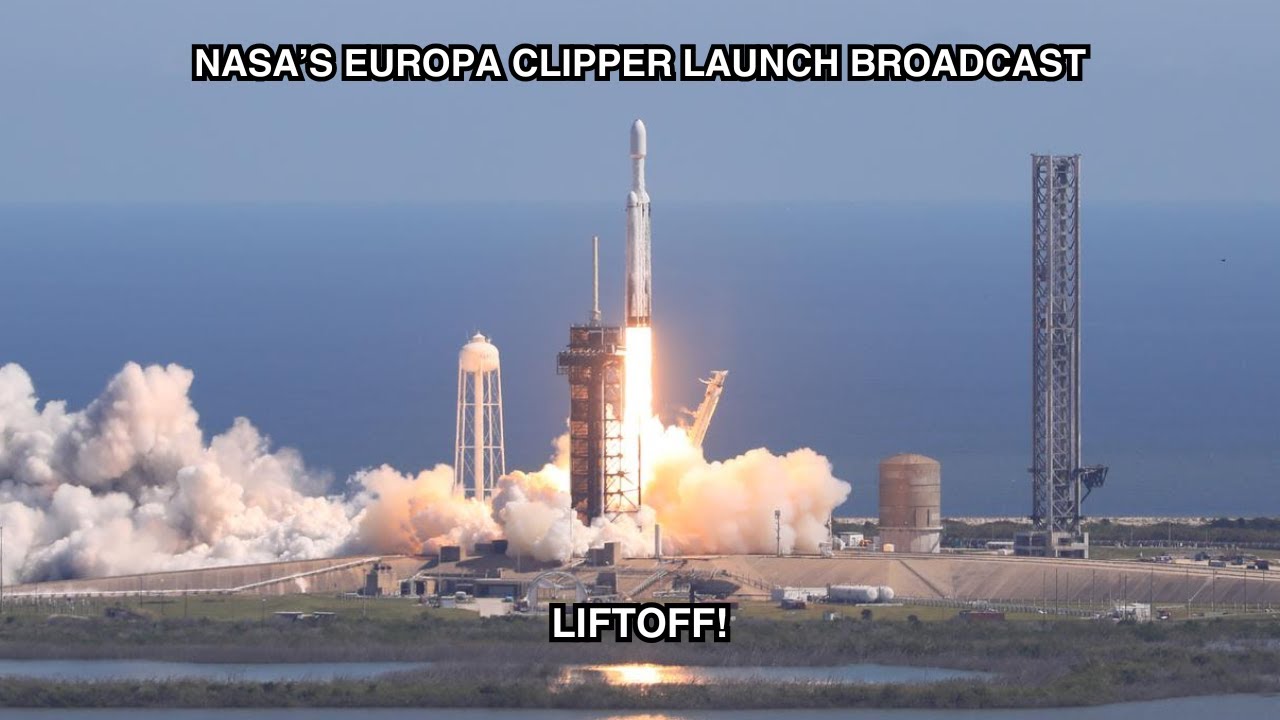
Europa Clipper will arrive at Jupiter on April 11th 2030.
The goal of the mission is to determine if Europa, the smallest of Jupiter’s moons possesses conditions suitable for life. In particular, Europa Clipper will: seek definitive evidence of the existence of a vast water ocean beneath Europa’s thick ice crust; analyze the chemical composition of Europa’s surface, atmosphere and potential ocean; perform geologic measurements and find evidence of geothermal activity.
After its arrival, Europa Clipper is planned to complete 75 orbits around Jupiter and perform 49 flybys of Europa.
This orbit plan is designed to avoid orbiting Europa directly and exposing the spacecraft to the intense radiation effects caused by Jupiter’s magnetosphere.
Gravity-assists from Europa, Ganymede and Callisto will be used to target different Europa close approach points on each flyby, the closest of which will be at altitudes of about 25 km.
If somebody or something wanted to imprison the human race on a planet, they couldn’t do any better than the situation we find ourselves in.
It’s virtually impossible to leave earth and reside anywhere else.
We need a regulated mix of gases, not least of which is oxygen, we need food, water, and gravity. Too much gravity and our muscles couldn’t cope, too little and our muscles will deteriorate and wither. And compared to the extreme temperatures found elsewhere in space we survive in a very limited range.
A long way - sometimes a very long way and sometimes a mentally long way. The earth is 150 million km from the sun and Jupiter is 778 million km from the sun. But both are moving so the distance might be as little as 628 million km or as much as 928 million km. In reality the little spacecraft will need to follow a carefully calculated ellipse to intersect with the path of Jupiter. Who knows how long that will be - got to be at least 800-900 million km of travel. As a comparison the earth has a circumference of 0.04 million km. Earth to moon is 0.4 million km. I think that over 2,000 times further than going to the moon - which takes 3 days.
Go faster, you suggest. There are two problems with that. Sufficient fuel burn to accelerate the craft … remembering how much fuel it takes just to get out of the earth’s pull. And then, perhaps a bigger challenge, stopping at the other end.
Thanks for that - 93 million eh? Well now you’ve given it in miles I can really visualise that distance. With 150 million of your kilometres I was completely lost. But miles, lots of references to relate to. Such as London to Edinburgh is about 400 miles. So 93 million is that journey plus 92,999,600 miles further. I can picture that now, ta.
Besides that, I’d like to see anyone to the calculations for inter-planetary routes using imperial measures.
I agree Graham, definitely miles for interplanetary positioning and space travel distance, imperial has been pushed out a bit now, possibly since the utilisation of Telemetrics.
Or AU as a unit.
But, whether or not this US organisation uses miles when talking about distances (its American, and they don’t understand metric or even sensible temperature measures), no sane person would embark on a calculation that involves distance, time, gravitational pull of multiple bodies, vectors, mass, speed, etc and stick with any imperial unit. NASA certainly do their calcs in metric. I believe they then re-calculate the metric number (say altitude) from metres back into feet for the benefit of the crew or the viewing (American) public.



 No, it is just a bloody long way