
It’s just a money thing Bruce, with no consideration of the environment, efficiency, or the needs of the average person. But at the end of the day, it’s funded by you and me.
They are being reckless with our money and just don’t care.
Thank you for (gently) educating me on this matter. Much appreciated. 

1 Like
From a thread about contrails and in which cars and planes exhausts were mentioned.
Unlike gas turbine electricity stations?
Just returning to original topic for a moment…
Tween Bridge, the 800mW solar farm and associated 400mW lithium battery storage facility quote there will be enough electricity for
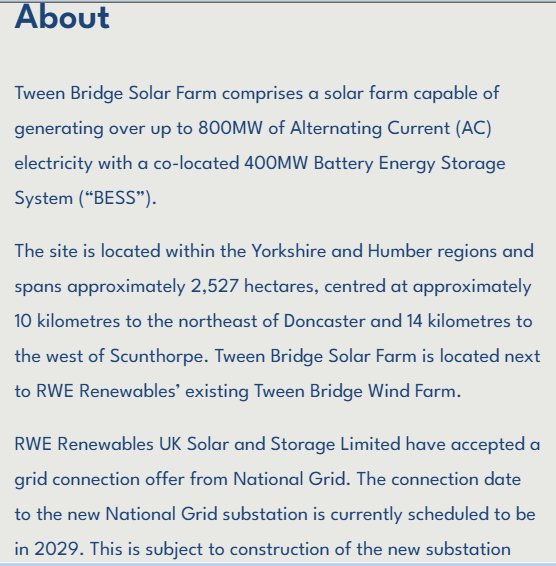

Increased energy generation output to 800MW, equivalent to powering 370,000 homes.
After calculating my energy usage over a five year period I arrive at an average of 2567kWh per quarter, or 28.5kWh per day.
Therefore, the 400mW battery storage will supply 320,000 homes for just one hour.
Of course the solar panels will not be contributing during the hours of darkness. so once the batteries are charged to capacity, the rest of the 800mW will go to earth…
Just saying…
I think your calculations are wrong - batteries are usually measured in Amp hours are they not? I can see no reference to that in your quotes. 400Mw is an instantaneous load how long it can be maintained depends on the Amp hour capacity of the battery.
I think that the 400Mw quotes are intended for the general public to indicate that it is big you need more information to determine its capacity.
Just saying…
Quick query, since Google isn’t really making it clear to me. What’s the life expectancy of these lithium batteries? I know that it depends on several factors, but for those of an engineering mind, any chance you could give something a bit more definitive than “between 2 and 15 years” ?
I don’t know exactly but the ones supplied for homes here are guaranteed for 10 years so I guess that would be the minimum. Actually that is the same as the guarantee for home hot water heaters at least the old type with an element.
I did read somewhere that car batteries are lasting longer than expected but what is expected i don’t know.
1 Like
Thanks. Just wondering if these estimated renewal costs are built into the profit margins (for investors as well as carbon footprint) when developing eg solar farms. My understanding, based on very low knowledge, is that battery maintenance/replacement is far from a cheap hobby.
I’m out with a couple of engineering friends (one chemical, one electrical) in a couple or so weeks time. Maybe they’ll have more recent experience. No offence, btw
1 Like
It’s in their official text Bruce, I did my calculations assuming that the 400mW were actually 400mWh …I doubt that 400mW would only be a one shot burst.
And electricity here is charged by the kWh and not Ah. But with your knowledge it should be easy to convert from mWh to Ah knowing the voltage here is 240 volt ac.
I suggest Ohms law…
Here’s a reminder if you’ve forgot…
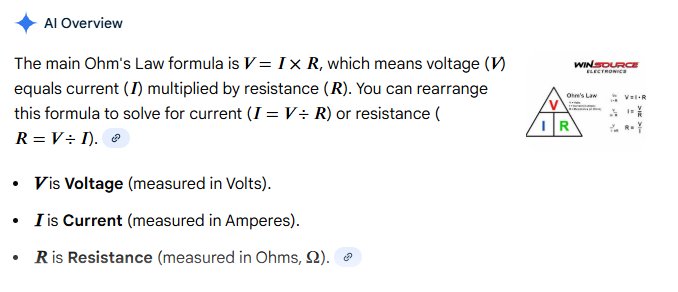
A single lithium cell is 3.7 volts DC and it’s output is measured in Ah (Amp Hours)
It’s ability to provide one amp for one hour, or a multiple thereof…
In order to arrive at the voltage and power (amps) output required the cells are arranged in series and parallel.
It would be unusual for the whole battery to fail unless damaged, but single cell failure will reduce the output, hence it’s failure to hold the same charge as when new.
It’s why this laptop held a 10 hour charge when it was purchased, but now…8 years later, a full charge will only last two hours, if I’m lucky. The benefits of lithium batteries are that they don’t tend to lose a charge when sat on a shelf for long periods, unlike a nickel cadmium battery (NiCad).
That’s about all I know about lithium batteries Dex, I hope it has been helpful. There is more info here in this link…If you learn anything interesting from your friends, I’d be very interested in what they have to say…
1 Like
They are breaking down early, causing fires and putting most all in jeopardy…
No way; I will ever charge one inside my garage. I most likely will construct
another drive, with a Roof over an open area on cement to charge them if i haff 2
Slamming that kind of power back into a battery on a Rain Day seems crazy.
1 Like
When I said instantaneous I didn’t mean that literally I meant that it could generate 400MW for a minute, an hour, a day or a week the time is not specified. It is only specified when you say Amp hours, Mwh or KWH which they don’t. You can’t just make the figures up.
The Machines I worked on were 100mW machines they could generate 100MW for ever as long as you fed coal into the boiler and nothing broke down.
You are combining figures without sufficient information.
Yes I know all that but…
A little knowledge is a dangerous thing OGF, you are talking about AC current, Ohms Laws needs to take into account phase angle too.
There is real power and apparent power (VA), they charge for the former but would like to charge for the latter. MVARs are free (insider joke)
These graphs are meaningless as we are in transition from fossil fuel to renewable energy it takes time, you and I will be long gone by the time things completely turn around

1 Like
Electricity in the UK is charged by the kWh…The reason for this is because if it was charged by the amp, it would vary too much. The voltage in the UK can be anything from 230 v to 250 v I monitor it regularly, and if the voltage goes down, the amps will go up, and visa versa.
The measurement in watts never changes as it’s a measurement of energy derived from volts multiplied by amps, so it always remains the same energy wise…No fluctuations.
My figures were correct (no apology required) I calculated my figures assuming that the 400mW was 400mWh, and I was proved to be correct because they quoted 370,000 homes and I quoted 320,000 homes. Probably because they always quote assuming using the best case scenario, when the batteries will be fully charged…But they won’t always be fully charged in the winter when demand for electricity is high and the nights are long.
Also, my figures (that were also accurate) were an average taken over one year on my own electricity usage…(I have records of all my energy usage from 2006 to the present)
The 100MW machines you worked on were continuous, batteries are not continuous after they start to lose their charge.
That’s my whole argument…Why use something (solar panels and wind turbines) that are not continuous?
They are also unreliable. They generate power when you least need it.
They cover far too much land to be of any use, and in the UK we don’t have that much land spare as in Australia with it’s vast areas of nothingness and wall to wall sunshine…
I think your comment of a little knowledge, was uncalled for, I don’t claim to know everything about electricity, and neither do you…
It doesn’t work that way I am afraid.
Amp hours are how batteries are classified though probably in these cases probably kilo or mega amp hours. It is a measure of capacity, from that information you can work out how long the battery would last. if you know the load but the information you have is not sufficient.
Quoting number of homes is a meaningless marketing exercise.
1 Like
I understand what you mean about batteries Bruce, and under normal operating parameters you are quite correct…However, these are the figures displayed by the company, not me.
And because this type of multi battery use to supply the national grid, it’s the way they choose to demonstrate the potential of the facility.
Most of the people they are trying to convince for permission to build a solar farm and associated battery storage facility have very little knowledge of power generation and distribution and they need to know what it means in real terms, like, how many typical houses will it supply. So they made a calculation based on the available projected potential and came up with 370,00 houses…Their figures, and their calculations,not mine…
Using the same method of calculation and based on my own energy usage, I arrived at 320,000 houses, and because the facility will not be accepting a charge from solar panels at night, once they have discharged there would be no more charging until daylight, so 320,000 houses would be supplied for only one hour. Or…160,000 houses for 2 hours…
Which I find pathetic and not worth the cost.
Their showing Melissa peak wind speeds were 252 MPH>
Shat’s hapening people and quickly most likely!
What I have noticed from 9 amp to 2 amp 20 volt lithium is the amount of leaves blown.
The batteries last about equal in time used & needing charged. Basically one can’t
screw around long.
1 Like
I much prefer ‘plug in’ stuff, and then you can blow leaves until your hearts content…All night if you desire.
1 Like
I buy a 2 cycle 200 mph every 3 years just because I believe tis the best.
The 24 volt and 48 volts are for quick clean up drive and Garage, blow
off jobs of Acorns, leaves and Fir dust / pinecones.
They don’t run the 100’s of hours needed to do the truckloads of leaves but they
last the Decade with new batteries.
1 Like