


…
2 Likes
Perhaps. Or is it not more likely that a new paradigm arrives that creates a whole new type of market and product? It is interesting that this thread focuses on smart phones.
Back in 2004/5 I did quite a lot of work with Nokia up in Helsinki. This was when they were the biggest phone maker in the world. They launched something like 5 or 6 new phone designs a year at that stage. They have managed to get the time spent on “concept to design to production to replace with the next one” cycle down to 11-12 months. They did this to chase the new product buzz going, to overwhelm the competition with new stuff and to cover all the different customer needs.
Then Apple launched the smart phone and the rest is history. See also Kodak and digital cameras, arguably an even more interesting story.
1 Like
All of us currently on this forum will not be around to participate in the indignity of such an outcome. 
3 Likes
“the perennial gale of creative destruction”
4 Likes
Cor I like that … did you dream up that one yourself. Very prophetic and insightful.
2 Likes
would that I were so eloquent or intellectual. It was Mr Schumpeter. The scary thing is that Schumpeter lived way before the internet was a figment of anyone’s imagination (he didn’t even live to see Farenheit 451, which alluded to social media, published) yet he would not be surprised at all about AI.
His prediction was apparently that capitalism would fall because it would be destroyed from within rather than through any violent revolution. From what I read of his book (which I have somewhere), he thought capitalism would keep going as long as entrepreneurs kept innovating new ways for it to expand and continue.
2 Likes
Thanks for sharing. I’d not even heard of Schumpeter, shame on me. Glancing across his works and his theories, and when he developed them, it does me wonder if he would retain or revise his thinking if alive today? I’d certainly agree that capitalism does not seem threatened by revolution, at least not western capitalism. But might that be because capitalism has many players with huge interest in keeping capitalism going - and the resources to do just that? Certainly right now, capitalism as it stands, does not seem to be benefiting the majority or giving people all that they need.
2 Likes
Be careful what you wish for. We are all stakeholders in this particular experiment.
My main problem with capitalism is that it is a hungry beast with a growling stomach. I’m just worried that stomach is hungry because it’s so full of promises rather than real commodities. That says more about our modern financial systems than capitalism in itself, which after all is just the market system humans have had since the beginning of time.
My view has always been that regulation and control is absolutely necessary to keep markets in check and ensure competition and consumer choice prevails. But we are entering an era of total uncertainty because of AI and the job displacement that is already starting to take place. I’m just grateful to have lived in a normal world for most of my time here. Feel so sorry for the young and the uncertainty that they face/will face.
4 Likes
Let me first say that I really do agree with your post - especially the need for robust regulation to hold back the wilder behaviours that capitalism can encourage.
I’m interested in the notion that there has been a divergence from simple / traditional capitalism with the introduction of modern financial systems. And also if that simple capitalism is no more than the hand of the market.
I had understood that the market exists regardless of whatever -ism is in place. Capitalism is the system by which money is raised for investment, the investment is used to create a means of production, the risk lies with the investors, but so does the reward if the production results in a product that can be sold to the market at a price that provides profit. The market determines the price it can be sold at - driven by demand and competitor offerings. So in that sense capitalism feeds the market but is not the market.
The financial systems that adapt or change capitalism seem to me to be ones that take the risk away for the investors. The most obvious of these is the limited company - or to be more specific the limited liability company. This creates risk not the for the initiating entrepreneur - but more for the shareholders (ok, these are investors) and any debtors the enterprise involves. But worse now are hedge funds that seem to take little or zero risk in their investments. It strikes me that the reduction of risk for the entrepreneur means others carry the can … and that ain’t capitalism.
Other more modern financial systems - hedging, shorting, derivatives, etc. are surely just financial tools that need strong regulation and limits. I read that the futures market alone is many multiples of the world’s GDP. So if that goes wrong…
1 Like
Yes I meant financial instruments, futures, hedges, derivatives etc.
When they had the select committees after the last crash the problem was summed up by a committee member (or similar bright spark), who said words to the effect that they cannot keep using the excuse that nobody really understood how derivatives work.
3 Likes
The best and most readable (and most scary) book about the 2008 crash was by John Lanchester and called “Oops!”. Best written because he’s a writer rather than an economist or life long city worker. And the title sums up the attitude of the financial sector. Oops, soz, but just an accident, so no-one’s fault really.
2 Likes
that’s the sort of attitude that gives our financial systems a bad name. It simply shouldn’t happen but people get lazy about the rules. It’s an institutional culture and I doubt it has improved despite all the regulations. i think there should be more regulation throughout to encourage competition, but the world has gone in a different direction because large multinational companies will find a way around rules individual countries may impose. Plus there are vested interests via the financial markets to keep this going (as pensions and various public services will be invested). You might remember when that Icelandic bank went bust and various local authorities lost millions.
1 Like
The finance sector was very good at applying the easy regulation. So they really know their customer - just not the info that will spot criminals. And they check and double check everything to that they get 100% compliance - so much so that many mid-level managers’ role is checking forms, rather than perhaps managing. I’m referring to their commercial banking operations rather than ordinary customers. There they get lots wrong first and second time round.
The 2008 crash hit the banks of some countries worse than others - Iceland, Ireland and the UK were badly exposed to the risk. Canada on the other hand barely suffered. I met an ex-board director of ABN Amro. That was the bank that Fred the Shred made RBS overpay for. It seems a few years prior to that takeover the board welcomed two new directors - Americans and leads for their investment bank division. They told the board that they would make ABN the biggest bank in the world. They forgot to mention that they would also make it the riskiest bank in the world. By the time RBS came looking to buy it the bank was chock full of bad debt. It was one of the main reasons RBS went bust.
1 Like
I’m not familiar with the RBS acquisition of ABN. Surprising that their due diligence would not have discovered such a poor balance sheet.
1 Like
Interesting Bretrick, I came upon a situation the other day.
I was on a route that took me over the Humber Bridge.
There used to be toll booths collecting a small fee for passing over the bridge.
A few years ago you could toss a pound into a collection funnel and the barrier would raise.
Then it all changed and you were offered a machine to stick your card in…
Now I was shocked to find no toll booths and a sign saying “Pay on the internet”
Not even a phone number without finding it on the internet.
So this world is turning into a world where you will be excluded or ‘cancelled’ if you don’t have access to the World Wide Web…
I find this situation unacceptable.
2 Likes
If at times I am excluded or unable to purchase tickets etc, I move on. Don’t sweat the small stuff. Idiotic world we are living in.
It’s not small stuff though is it Bruce, just because driving over the Humber Bridge won’t ever be a problem for you, there will be other stuff that will affect you.
1 Like
Unacceptable while crossing the white elephant that is the humber bridge - but very common in any congestion charge or emissions charge zone. Or the Dartford crossing. Besides, didn’t the volume of traffic crossing the humber bridge fall to such a low level (because of the M18 being build) that it was costing more to collect than was collected?
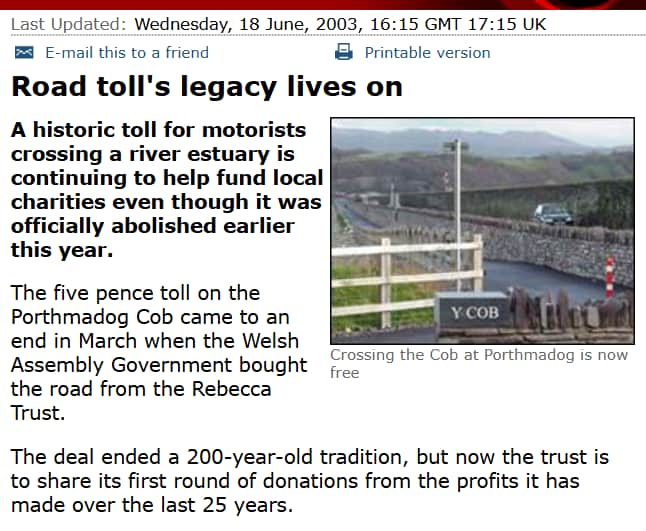
There used to be a man sitting on a chair in North Wales collecting 5p pieces from people passing through Porthmadog - I’m not posting the BBC news site link because my browser says it’s insecure, but here’s a screenshot. Brings back nostalgic memories of long summer holidays in that beautiful part of the world.
1 Like
I’ve heard it called a 'White Elephant in the past but I suspect all the people living in Hull who want to travel South or work in Scunthorpe, and visa versa.
Personally I’ve used the bridge frequently over the years, and walked, run, cycled and motored over the bridge many times.
As a self employed courier I used the bridge often while doing jobs for City Link, a large national parcel company, sadly ceased trading now. They had a main distribution centre in Scunthorpe but strangely not one in Hull. So each day vans left Scunthorpe for deliveries in Hull and surrounding areas. I think the tolls were issued on a yearly basis, or paid by tokens each day.
There are currently around 100,000 vehicles crossing the bridge each week, without the bridge it would add a considerable distance to the mileage of the 100.000 vehicles, so good for the environment despite not being profitable.
I doubt that the volume of traffic decreased due to the opening of the M18 motorway because the M18 was opened to it’s full length in 1975 and actually pre dated the bridge which was opened to traffic in 1981.
With no proper airport on the North side the bridge provides a good connection for travellers to use Humberside Airport on the South side.
All of the charges you mentioned are just examples of businesses shafting the working classes with people losing jobs and being replaced by computers. The internet will fail, whether it be from disruptions of electrical supply, attacks of terrorism, or natural environmental and weather related issues.