
Cars! Oh no! They’re tools. A exceptionally dangerous and expensive ones. Let’s talk about something more interesting. Erm, hammers. Let’s chat about hammers! 
1 Like
Dangerous? My field was industrial power electronics up to 11,000 Volts - now that’s dangerous !!
1 Like
Especially if you hit them with a hammer. 
Or with an Ammeter !
2 Likes
Boom, boom. Possibly quite literally, Bes. 
Proper motors JOC…
They can practically drive themselves just lately…Wait a minute… 
Ha Ha, when I worked in the power industry 11kv was about where our voltages started.
1 Like
Yes, indeed. And it is a serious matter for us and it can be just one mistake. That one mistake almost caused the death of a friend. It was in a paper mill where he mistook one section for another and he got electrocuted - 700 Volts DC. He survived but was in hospital for nearly a year.
1 Like
When ah were t’lad, we used to hang fire elements down from t’overhead pylon cables to cook roadkill rats…. Luxury, lad…
1 Like
How the hell can one survive 700V?? I assume tiny current?
My mate jumped off a haystack and tried to grasp an 1100 volt overhead cable.
It blew off two fingers and several toes…
He turned into a good engineer when he was older…That’s when I worked with him.
1 Like
Jeeez. That’s bonkers. Why would he do that? I used to bottle out of getting up to the bumps on a swing and leaping off at the top. Some people are fearless!!
Not me!
1 Like
We had a crazy here, he jumped off a train, and lost two toes, we kincked his stolen stash, live dangerously 
2 Likes
It was one of the variable speed drives on a large paper machine so tiny it was not. I imagine he he touched only one hand and touched that fleetingly - I wasn’t there at that time,
1 Like
Depends where the current flows. It will damage any organ in its path but I guess arm to arm would be the worst because the heart is in the middle.
Even minor electrical shocks can do damage that is not apparent until later.
Personally I have only known one person who died and that was due to a failure of procedure when a boilermaker removed a cover of a precipitator, sat down and dangled his feet in to wait for his paper work, it had just been livened up and he received 100s of thousand of volts DC. (the actual failure is a much longer story)
BTW DC is the worst because it doesn’t allow you to let go (mind you that might be the least of your worries).
Have seen a few ashen faced colleagues who, for example, inserted a circuit breaker where the earth bar had snapped off in situ. When the site was inspected the surrounds of the breaker had metre long scorch marks where flames had erupted. He was fine, just scared shitless from being in the centre of a firestorm.
I have been showered with molten metal (well, very close to me) when a circuit breaker failed and the only way to isolate it was to open an Isolator (not designed to be opened on load) - I was wearing a lot of thick leather protective clothing from the boiler maker shop 
2 Likes
These are horror stories indeed. I’ve had a few petty 240V when a kid (my father used to fix tv’s and was somewhat blasé about electrickery at times). The occasional shock from an old TV tube is a very steep learning curve for child!!
1 Like
Imagine how Prof Pieter van Musschenbroek felt when he received a shock of over 50,000 volts from a Leyden Jar.
It threw him across the room so fast he almost died and was later quoted as saying…
“I would not repeat the experiment if offered the Entire Kingdom of France”
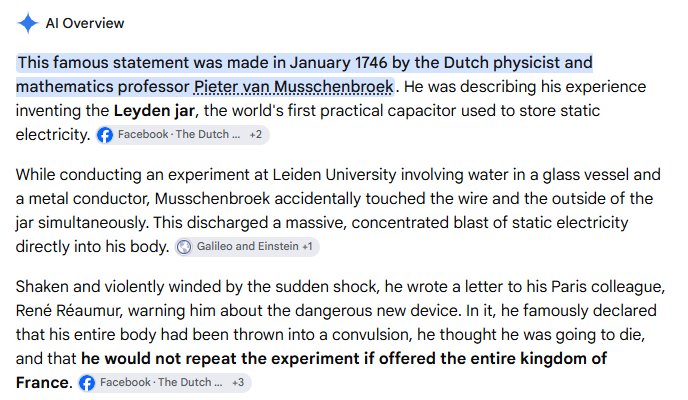
Mathematics Teachers beware!
1 Like
As if…
Meanwhile …

1 Like
As I understand it, only a few milliamps is required to kill a person.
My first electric shock was when I was working on a high voltage power supply for a radio transmitter, we always worked on them live because turning them off meant hours of work retuning the transmitter.
This was in the days of valves and I was checking some components (I forget why - this was sixty years ago), one of the rectifiers had a cap on the top of the valve on which I occasionality rested my arm, as I had done a dozen times before.
A valve similar in design to this type - see the connection on the top

Unfortunately this valve’s insulated cap was cracked and my forearm also touched the frame as I was working, next thing I knew I was slammed against the wall. A painful lesson.
Unlike transistors, valves often use very high voltages sometimes in the thousands of volts. As @Dextrous63 pointed out a TV tube is nothing more than a very large valve
1 Like
Hi Bruce. You know I’m an old phart and I had some experience with triononic valves around 300V dc. One of my projects was to replace them with semiconductor thyristors. Life moves on…
1 Like